Threat Intelligence Lifecycle Explained: How Security Teams Turn Raw Data Into Action
Threat Intelligence Lifecycle Explained: How Security Teams Turn Raw Data Into Action
Modern security teams are flooded with alerts, feeds, logs, indicators, and advisories every day. But more data does not automatically create better security. Threat data only becomes valuable when it is processed, analyzed, and turned into intelligence that teams can actually use to prioritize risk, detect faster, and respond with clarity. That is exactly why the threat intelligence lifecycle matters.
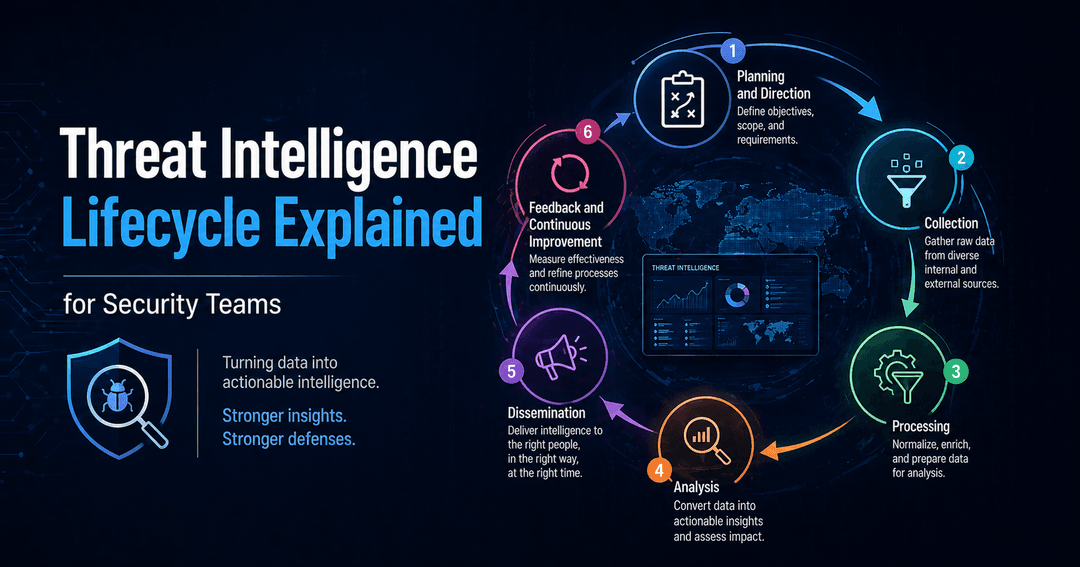
At its core, the threat intelligence lifecycle is a structured, continuous process that helps organizations define intelligence requirements, collect relevant data, process it, analyze it, share it with the right stakeholders, and improve through feedback. Rather than reacting to every alert with the same urgency, security teams can focus on the threats that are most relevant to their business, industry, assets, and attack surface.
That structure matters even more in 2026. IBM's Cost of a Data Breach Report 2025 says the global average cost of a data breach is USD 4.44 million, while the average time to identify and contain a breach is 241 days. IBM also found that organizations using AI and automation extensively reduced breach costs by USD 1.9 million and shortened breach timelines by 80 days. In parallel, IBM's 2025 X-Force Threat Intelligence Index found that nearly half of cyberattacks resulted in stolen data or credentials, and identity abuse was the preferred entry point. Together, those findings show why threat intelligence programs must be faster, more focused, and more operationally useful.
What Is the Threat Intelligence Lifecycle?
The threat intelligence lifecycle is a repeatable framework that transforms scattered cyber data into actionable intelligence. It helps organizations move beyond passive monitoring and toward informed decision-making by connecting technical signals to operational priorities and business impact.
Without this lifecycle, many organizations end up collecting large volumes of security data but still struggle to answer simple questions: Which threats are actually relevant to us? Which indicators need action now? What should analysts investigate first? What should executives know from a business-risk perspective? A mature lifecycle helps answer those questions in a disciplined, repeatable way.
The 6 Stages of the Threat Intelligence Lifecycle
1. Planning and Direction
Every successful threat intelligence program starts with clarity. In this first stage, security teams work with business stakeholders to define what needs protection, which threats matter most, and what decisions intelligence should support. This is where intelligence shifts from a technical exercise to a business-aligned security function.
For example, one organization may prioritize credential abuse, phishing, and account takeover, while another may focus more on ransomware, supply chain exposure, or operational disruption. Strong planning prevents wasted effort and keeps the intelligence program tied to real business risk instead of generic threat collection.
2. Collection
Once priorities are clear, the next step is to gather the right data. Effective collection can include internal systems, security logs, endpoint events, network telemetry, open-source intelligence, industry sharing communities, dark web monitoring, and threat feeds. The goal is not to collect everything. The goal is to collect what supports the intelligence requirement.
Focused collection is critical because uncontrolled data intake creates noise, slows analysis, and increases fatigue across SOC and threat teams. Selective collection gives analysts a cleaner signal, a better view of relevance, and a stronger starting point for prioritization.
3. Processing
Raw threat data is rarely ready for action. Before analysts can rely on it, it needs to be normalized, cleaned, enriched, validated, and deduplicated. Processing is the stage where scattered technical inputs are turned into something usable for investigation and decision-making.
This is also where automation delivers measurable value. IBM's 2025 findings show that security AI and automation can reduce average breach costs by USD 1.9 million and shorten breach resolution by 80 days. That makes processing maturity more than an operational benefit. It is a direct lever for reducing breach impact and improving security efficiency.
4. Analysis
Analysis is where threat data becomes intelligence. At this stage, teams assess patterns, correlate indicators, evaluate credibility, and determine what a threat means in the context of the organization's assets, industry, users, and likely business impact.
Good analysis helps answer the questions security leaders care about most: Is this relevant to our environment? What is the likely impact? How urgent is it? What action should we take now? Without strong analysis, organizations may have plenty of data but very little direction. With strong analysis, they gain sharper prioritization, faster triage, and more confident response decisions.
5. Dissemination
Threat intelligence only creates value when it reaches the right people in the right format. Analysts, SOC teams, incident responders, and executives do not all need the same output. Tactical teams need detailed indicators and actionable context, while business leaders need concise insight tied to risk, disruption, and decision-making.
That is why mature threat intelligence programs tailor dissemination by audience. When intelligence is distributed clearly and purposefully, it improves coordination, accelerates response, and helps technical teams and business stakeholders act on the same reality. When it is not, intelligence becomes another unread report.
6. Feedback and Continuous Improvement
The threat intelligence lifecycle is continuous, not one-and-done. Feedback from SOC teams, incident responders, leadership, and risk owners helps refine future collection priorities, improve reporting quality, and remove inefficiencies from the program.
This final stage is what turns intelligence into a living function rather than a static reporting task. Threats evolve, business priorities shift, and attack surfaces change. A mature intelligence program improves over time by using feedback to sharpen what it watches, how it analyzes, and how it supports operations.
Why the Threat Intelligence Lifecycle Matters in 2026
Threat intelligence is no longer just a support capability for large enterprises. In a threat environment shaped by credential theft, identity abuse, AI-related risk, and faster-moving attacks, security teams need a framework that helps them filter noise and act with precision. IBM's 2025 research shows both the financial impact of breaches and the operational value of faster, smarter security processes.
A defined lifecycle helps organizations reduce alert fatigue, improve detection quality, prioritize the threats that actually matter, and strengthen alignment between technical teams and business stakeholders. In practice, it turns threat intelligence from a feed-management exercise into an operational capability that supports resilience.
Common Mistakes Organizations Still Make
One of the biggest mistakes is overcollection. Teams ingest too many feeds, too many alerts, and too many indicators without enough direction. Another is treating threat intelligence as a purely technical activity, with little connection to business context, executive communication, or measurable operational outcomes.
Organizations also lose value when they fail to tailor outputs by audience or when they never build a feedback loop into the process. The strongest programs are usually the most disciplined: they start with business priorities, collect selectively, automate where practical, analyze with context, and continuously improve.
How ProTechmanize Can Help
At ProTechmanize, threat intelligence should not sit in isolation. It should strengthen the wider security function. ProTechmanize's service portfolio includes Threat Intelligence and Monitoring, SOC as a Service, Managed Detection and Response, and Incident Response and Forensics, helping organizations connect intelligence with detection, investigation, containment, and post-incident improvement.
This matters because intelligence has the most value when it can drive action across security operations. ProTechmanize positions itself as an end-to-end cybersecurity partner, combining consulting, implementation, support, governance, monitoring, and response to help organizations improve security maturity in a practical way.
Conclusion
The threat intelligence lifecycle brings structure to modern cyber defense. It helps organizations move from collecting raw data to understanding threats, from reacting to alerts to prioritizing risk, and from scattered reporting to clear, actionable security outcomes.
In 2026, that discipline matters more than ever. IBM's latest breach-cost and threat-index findings show that organizations are facing expensive breaches, long response timelines, rising identity-based attacks, and growing pressure to improve security efficiency. A well-run threat intelligence lifecycle helps security teams meet that challenge with better focus, better speed, and better decisions.
April 28, 2026
CategoryResearch